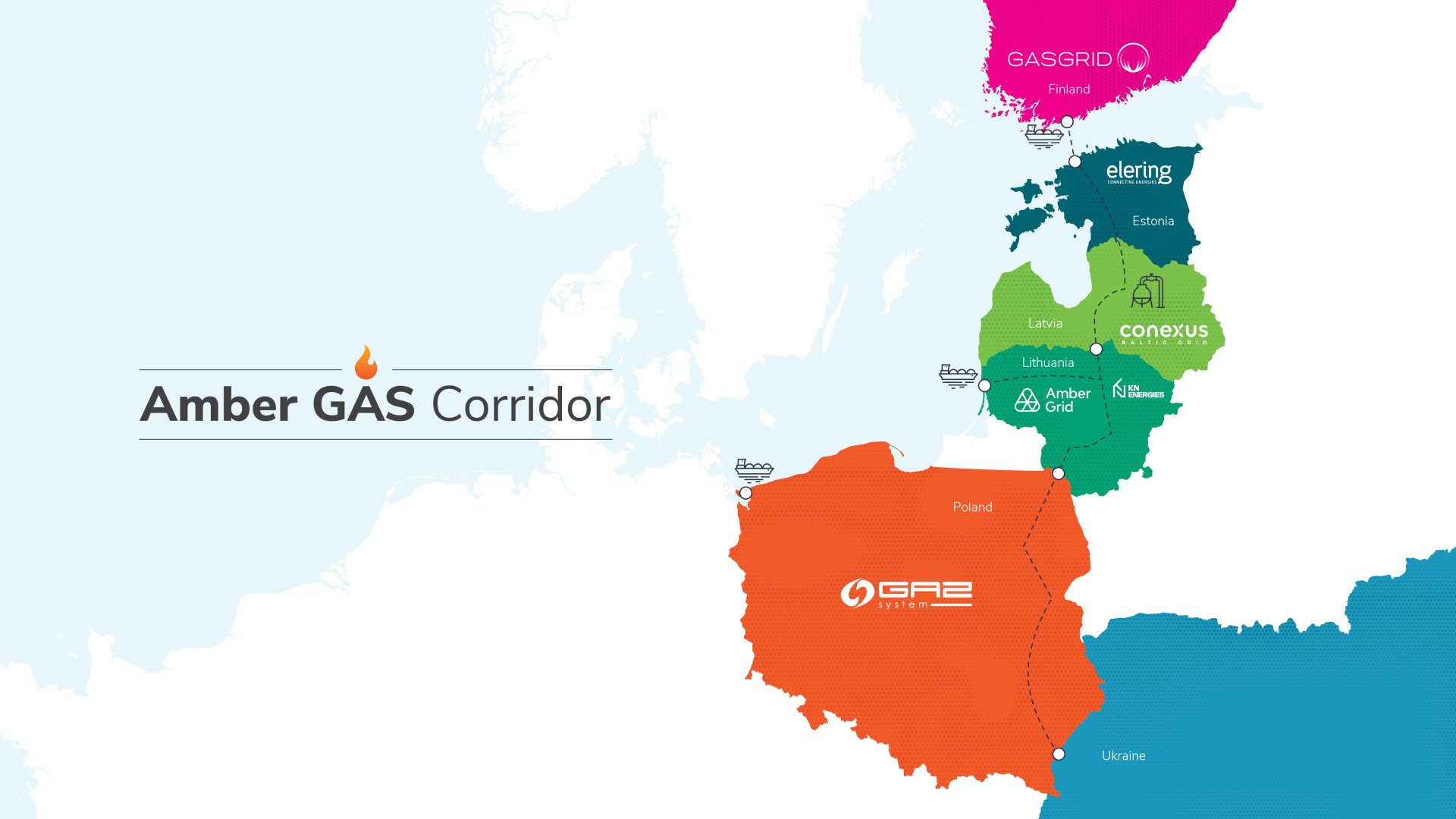
Amber Gas Corridor is a joint initiative of Amber Grid, KN Energies, Conexus Baltic Grid, Elering, Gasgrid Finland and GAZ-SYSTEM, aimed at facilitating efficient and reliable gas transportation between Finland, the Baltic States, Poland and Central & Eastern Europe. Based on existing LNG terminals, gas transmission interconnections and storage facilities, the Corridor provides reliable and flexible gas transportation between Finland, the Baltic States, Poland towards Ukraine. Market participants benefit from diversified supply sources, integrated regional markets and access to gas trading opportunities via EEX and TGE.
LNG Import Infrastructure
LNG terminals serve as the main entry points to the Amber Gas Corridor, ensuring flexible and diversified gas supply:
- Klaipėda LNG Terminal (Lithuania)
- Inkoo LNG Terminal (Finland)
Transmission System Interconnections
Gas transportation is carried out through cross-border interconnections, ensuring bidirectional gas flows between the Finland–Baltic and Polish regions:
- Balticconnector pipeline (FI–EE/LV) - connects the Finnish and Baltic gas markets, enabling bidirectional gas flows between Finland and Estonia.
- Kiemenai Interconnection Point (LT–LV/EE)- ensures bidirectional gas flows between Lithuania and Latvia, provides access to the Inčukalns gas storage facility, and enables further bidirectional gas transportation between Finland and the Baltic States via the Balticconnector pipeline.
- Santaka Interconnection Point (LT–PL)- connects the Baltic gas transmission systems with Poland and enables further bidirectional gas transportation between the Baltic States, Poland, and the Central and Eastern European gas markets.
- Polish Cross-Border Interconnections (PL)- within the Polish transmission system, the Amber Gas Corridor continues through seven cross-border interconnections with Denmark, Germany, the Czech Republic, Slovakia, Ukraine, and Lithuania, enabling bidirectional gas transportation between the Baltic Sea region and Central and Eastern European markets.
Gas Storage Infrastructure
Gas storages facilities ensure seasonal and short-term system flexibility and contribute to regional security of supply:
- Inčukalns Underground Gas Storage (Latvia)
- Gas Storage Poland (Poland)
Market Integration and Commercial Framework
Within the Amber Gas Corridor, market participants can transport gas under favourable and flexible conditions:
- The Finland–Estonia–Latvia common tariff zone applies no internal transmission tariffs; only entry and exit tariffs to the common tariff zone apply.
- The common Estonia–Latvia balancing zone simplifies gas transportation processes.
- In Poland, market participants benefit from free access to online capacity booking platforms and the secondary capacity market.
Gas Trading within the Amber Gas Corridor
- Gas trading in the Baltic–Finnish region (LT–LV–EE–FI) is carried out via a common trading platform operated by the European Energy Exchange (EEX). The Implicit capacity allocation service, allowing market participants to acquire gas and transmission capacity simultaneously, is applied at the Kiemėnai and Balticconnector interconnection points.
- The Polish gas exchange TGE (Towarowa Giełda Energii) offers trading opportunities covering both spot and forward gas trading, supporting higher market liquidity and more flexible gas flow management.
Gas Trading within the Amber Gas Corridor
Projected 2027 Transportation Costs (EUR/MWh)
|
DESTINATION COUNTRY
|
DIRECTION
|
MONTHLY PRODUCT
|
QUATERLY PRODUCT
|
YEARLY PRODUCT
|
|
LITHUANIA-POLAND
|
LNGT (LT) → LT →PL
|
2,89
|
2,56
|
2,33
|
|
LITHUANIA-UKRAINE
|
LNGT (LT) → LT →PL → UA
|
5,05
|
4,5
|
4,1
|
|
FINLAND-POLAND
|
LNGT (FI) → EST → LV → LT → PL
|
3,87
|
3,41
|
3,11
|
|
FINLAND-UKRAINE
|
LNGT (FI) → EST → LV → LT → PL → UA
|
6,03
|
5,36
|
4,88
|
2026 Transportation Costs (EUR/MWh)
|
DESTINATION COUNTRY
|
DIRECTION
|
MONTHLY PRODUCT
|
QUATERLY PRODUCT
|
YEARLY PRODUCT
|
|
LITHUANIA-POLAND
|
LNGT LT → LT →PL
|
3,46
|
3,05
|
2,79
|
|
LITHUANIA-UKRAINE
|
LNGT LT → LT →PL → UA
|
5,78
|
5,14
|
4,69
|
|
FINLAND-POLAND
|
LNGT FI → EST → LV → LT → PL
|
4,43
|
3,91
|
3,57
|
|
FINLAND-UKRAINE
|
LNGT FI → EST → LV → LT → PL → UA
|
6,74
|
5,99
|
5,45
|
Value of the Corridor for Market Participants
- Easy market access. A clear and simple registration process enables quick entry to the Baltic–Finnish gas markets.
- Capacity availability. Capacities are often available at key cross-border interconnection points between Finland and the Baltic States, as well as between Lithuania and Poland.
- Transparent capacity booking. At interconnection points, capacities are booked via the GSA capacity booking platform, applying clear, transparent, and market-based allocation procedures.
- Competitive transportation routes. The corridor provides a reliable alternative to existing gas supply routes, ensuring competitive transportation costs and transparent pricing.
- Security of supply. Gas supply is supported by LNG terminals in Klaipėda and Inkoo, while additional system stability is provided by the Inčukalns and Gas Storage Poland.
- Route flexibility. Market participants can choose different transportation routes and shape gas flows from Finland (Inkoo) or Lithuania (Klaipėda) according to market needs.
For a concise visual overview of the Amber Gas Corridor route, infrastructure and key benefits for market participants, download the
Amber Gas Corridor leaflet.


