
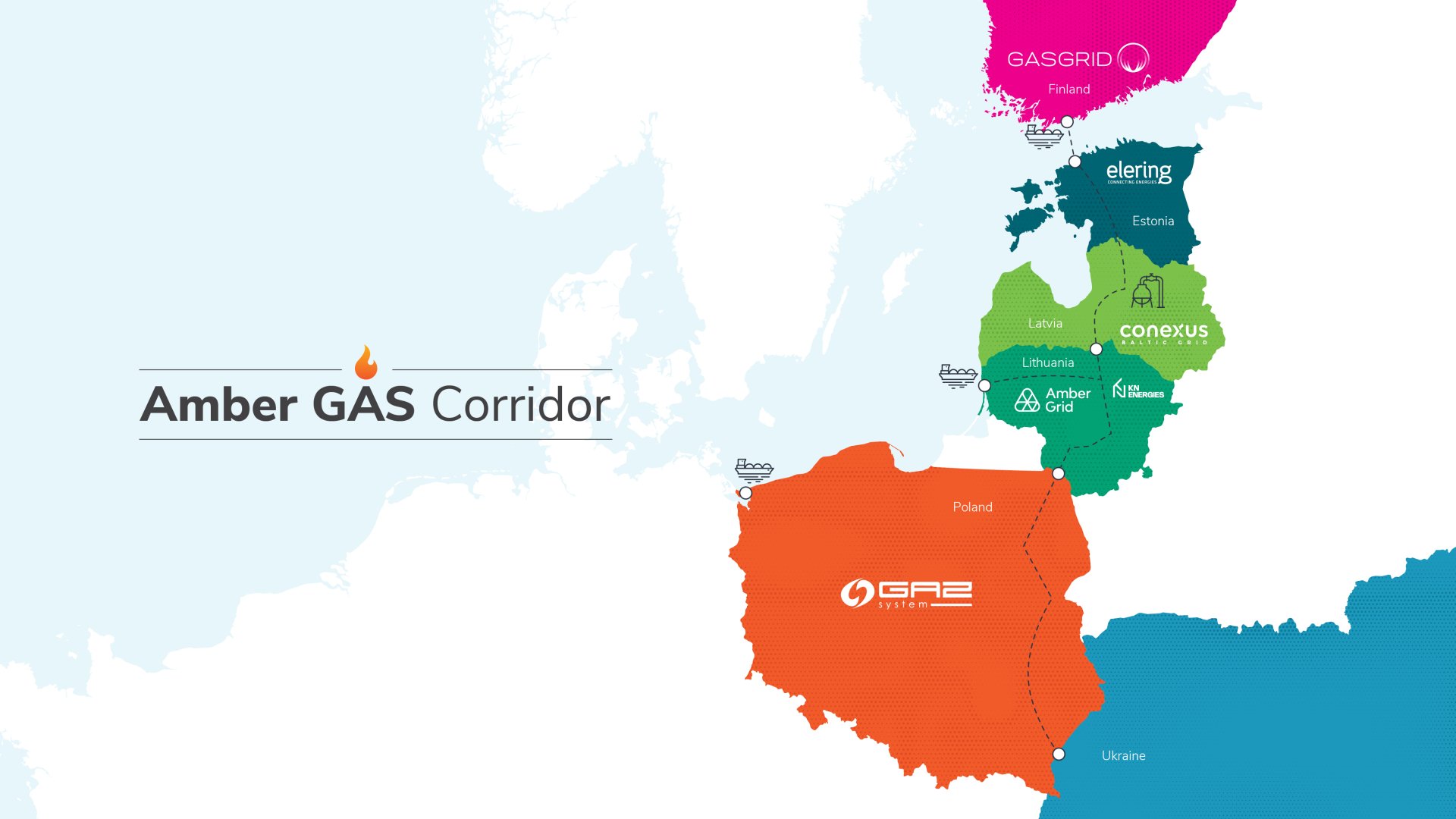
The "Amber Gas Corridor" initiative, presented to market participants at the end of last year, has attracted significant interest, as evidenced by the approximately 40% increase in gas transportation towards Poland this year. Gas suppliers using the regional gas transportation corridor connecting Finland, the Baltic states, Poland, and Ukraine can expect even lower transportation tariffs in 2027. These cost-reducing changes will enhance the competitiveness of the corridor's routes.
According to preliminary calculations, in 2027 the cost of transporting gas from Lithuania's Klaipėda LNG terminal to Ukraine (excluding the regasification tariff) will be 12–13% lower, depending on the capacity product selected. Transportation from Finland's Inkoo LNG terminal through the Baltic states and Poland to Ukraine (also excluding the regasification tariff) is expected to be approximately 11% cheaper on average.
These changes will result from planned tariff adjustments by transmission system operators in Lithuania and Poland. Lithuania’s natural gas transmission system operator, Amber Grid, forecasts that gas transmission tariffs at exit points will decrease by around 21% starting in 2027. Meanwhile, Poland’s transmission system operator Gaz-System has announced approximately 19% lower tariffs at the Santaka interconnection point on the Lithuanian-Polish border and around 14% lower tariffs at the Poland–Ukraine border exit point.
"The survey of gas suppliers conducted in February this year showed that two of the most important factors influencing the decision to use Amber Gas Corridor routes are competitive transportation costs and early access to information about future tariffs. In response to market participants' expectations, we aim to announce the 2027 route prices as early as possible so that suppliers can plan their supply strategies, assess the economic attractiveness of different routes, and make informed business decisions. It is encouraging that, based on the tariffs currently planned, gas transportation along these routes in 2027 will cost suppliers less than it does this year," said Nemunas Biknius, CEO of Amber Grid.
The Importance of Regional Infrastructure Continues to Grow
KN Energies, the operator of the Klaipėda LNG terminal, recently completed the allocation process for long-term regasification capacities for the period 2033–2044. During the process, the majority of available capacity—more than 20 TWh—was allocated.
Long-term capacity at the Klaipėda LNG terminal has been reserved by Ignitis, Latvia's Latvenergo AS, Norway's Equinor ASA, as well as two new terminal customers: Finland's Gasum OYJ and Ukraine's Naftogaz.
"Market participants have reserved terminal capacity for the long term. This demonstrates confidence in and the strategic importance of Lithuania’s gas infrastructure. It is particularly significant that Ukraine's Naftogaz is among the companies that secured long-term capacity at the Klaipėda LNG terminal. This clearly indicates market interest in routes capable of ensuring reliable and competitive gas supply to multiple countries," emphasized Mr. Biknius.
During the first five months of this year, gas transmission from Lithuania to Poland through the Santaka gas metering station increased by 38%, reaching 2,223 GWh. The anticipated tariff reductions from 2027 are expected to further stimulate gas flows towards Poland and Ukraine.
The Klaipėda LNG terminal remains the region’s primary gas supply artery. Since the beginning of the year, 15,688 GWh of gas has already been transmitted through the terminal—28% more than during the same period last year (12,226 GWh).

