
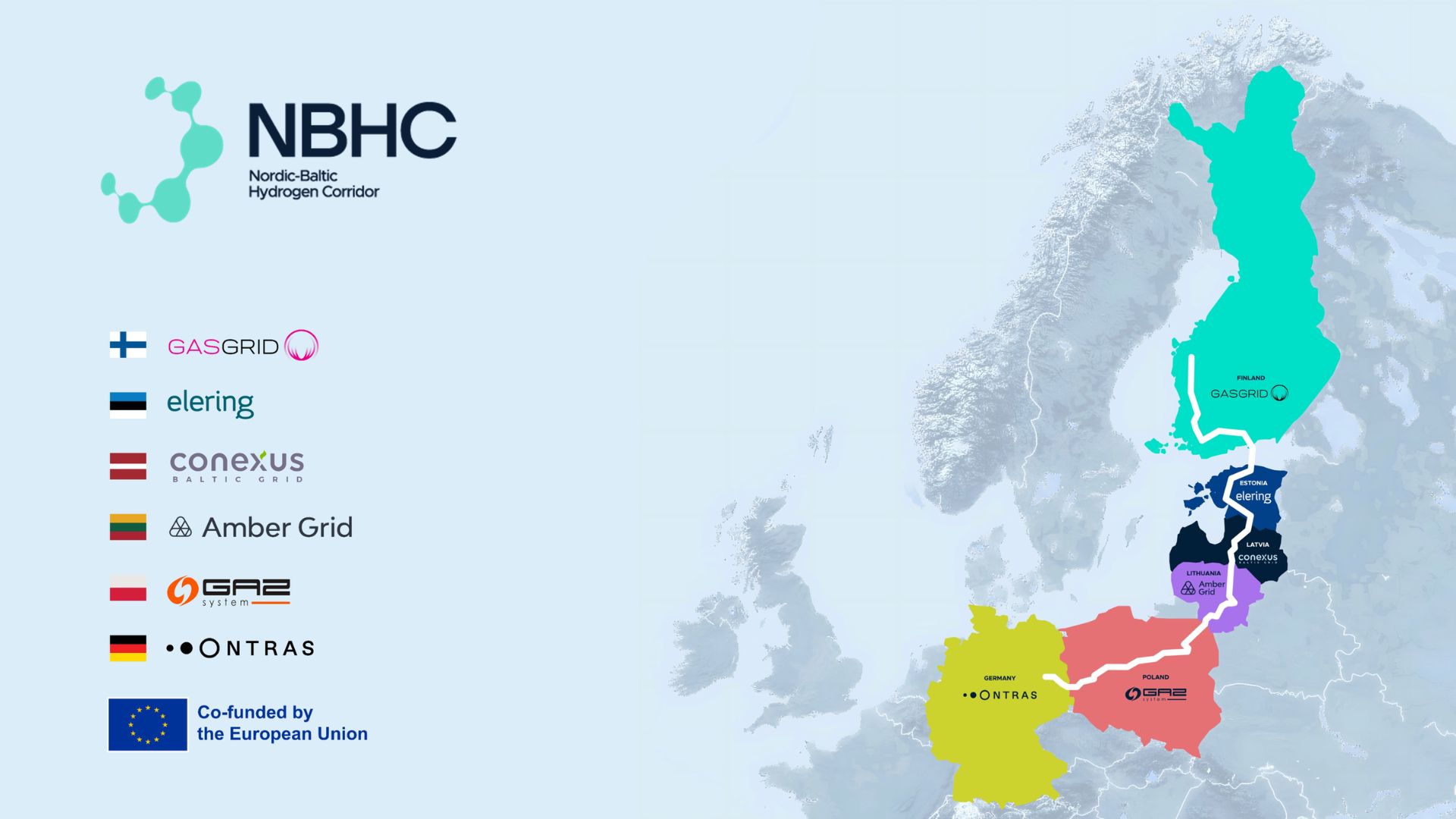
According to the results of the international hydrogen market survey, by 2040 annual demand for the Nordic-Baltic Hydrogen Corridor (NBHC) could reach 79.2 terawatt-hours (TWh) — representing approximately 87% of the corridor's theoretical 91 TWh capacity projection established in pre-feasibility studies. The results were published by the transmission system operators of six countries — Finland's Gasgrid Vetyverkot Oy, Estonia's Elering, Latvia's Conexus Baltic Grid, Lithuania's Amber Grid, Poland's GAZ-SYSTEM, and Germany's ONTRAS Gastransport.
The Call for Interest (CfI), aimed at identifying demand for the future hydrogen corridor infrastructure, was launched by NBHC partners in Q1 2026. Hydrogen producers, consumers, distribution and storage system operators, and hydrogen transporters across all six participating countries were invited to submit preliminary information on planned hydrogen production, consumption, and cross-border transport needs. The comprehensive survey results largely align with earlier feasibility-study projections. Clearly expressed capacity needs from project developers and system users confirm that this infrastructure is a vital and promising European energy artery, expected to become commercially operational around 2033 and beyond.
The international market survey received 93 responses from 81 distinct companies, representing 108 projects. Of the projected 79.2 TWh in demand, 64.4 TWh will come from dedicated industrial projects, and 14.8 TWh from German distribution networks.
According to Amber Grid CEO Nemunas Biknius, these results provide a solid structural basis for the hydrogen corridor connecting Finland, Estonia, Latvia, Lithuania, Poland, and Germany.
"The market survey results show that project developers and market participants across the region — including in Lithuania — are already clearly expressing their needs for hydrogen infrastructure. This is an important signal: Lithuania can become not just a transit country, but an active participant in the hydrogen market. The next step is to turn these needs into concrete commitments and investment decisions," said N. Biknius.
Regional supply and demand dynamics
Regional data reveals a closely integrated system, in which supply from the northern regions directly meets demand in the southern regions.
Finland is expected to play a key role in hydrogen production. Production is projected to more than double — from 15.4 TWh in 2033 to 38.6 TWh by 2050 — while domestic consumption is expected to remain stable at around 2.1 TWh annually.
The Baltic States will become both producers and consumers in a growing regional hydrogen market. Regional production is projected to grow from 3.4 TWh in 2033 to 11.1 TWh by 2050, while consumption over the same period is expected to rise steadily from 0.2 TWh to 4.5 TWh.
Poland's market shows a dynamic profile, with heavy industrial consumption consistently outpacing domestic supply. Production is projected to grow from 2.8 TWh in 2033 to 13.2 TWh by 2050, while demand is expected to surge from 11.8 TWh to 32.4 TWh over the same period.
Germany will become the network's primary destination and largest consumer — survey responses from Germany related exclusively to offtake. Direct project consumption is projected to grow rapidly, nearly tripling from 15.3 TWh in 2033 to 44.4 TWh by 2050.
Hydrogen for the broader market
Hydrogen will reach Germany not only directly, through large-scale industrial connections — a substantial additional flow into the country will also come through distribution system operators serving smaller consumers.
Demand through distribution networks in Germany's eastern regions — driven mainly by medium-sized enterprises and municipal utility providers — is expected to grow from 3.0 TWh in 2033 to 24.9 TWh by 2050.
The latest findings from Germany's national hydrogen market survey indicate that overall long-term German demand may exceed the projections identified in the CfI survey — further reinforcing NBHC's position as a critical supply artery.
Cross-border hydrogen transport data reveal demand for an international hydrogen corridor. System users and trading market participants indicated plans to increase transported volumes from 25.4 TWh in 2035 to 38.2 TWh by 2050. A significant share of these volumes remains flexible in destination, signaling the early stages of a liquid European hydrogen trading market, in which early movers secure transport capacity in advance in order to sell hydrogen into the highest-paying markets.
Approaching the 2027 milestone
The NBHC project is being implemented according to the plan agreed by the partners and is currently in the feasibility phase. The participating transmission system operators — Finland's Gasgrid Vetyverkot Oy, Estonia's Elering, Latvia's Conexus Baltic Grid, Lithuania's Amber Grid, Poland's GAZ-SYSTEM, and Germany's ONTRAS Gastransport — will continue engaging with market participants to further assess capacity needs and possible pathways for project development. Technical and commercial studies are currently underway and are expected to be completed in 2027.
"The survey results show that the market is still at an early stage of development, with uncertainties remaining around future volumes and project implementation timelines. This underscores the need to establish a stable, supportive regulatory environment that enables timely investment decisions and supports the consistent development of hydrogen infrastructure," explained N. Biknius.
The project remains open to additional input from market participants.
More information and the full CfI report are available here.

Co-Funded by the European Union. Views and opinions expressed are however those of the author(s) only and do not necessarily reflect those of the European Union or CINEA. Neither the European Union nor the granting authority can be held responsible for them.

